


I’m working on some new short-row colourwork projects – some of which are secret, some aren’t! – and I thought I’d ask you what else you would like to know about the technique?

My best selling (it still feels so weird to say that!) Short-Row Colorwork – The Definitive Step-by-Step Guide book is crammed full of information. There is a LOT covered in it’s 192 pages.
It’s just turned a year since it was published, and in that time I’ve taught a lot of workshops and given a lot of lectures on the topic, not to mention extra photo tutorials and my new YouTube channel.
I’d like make sure I’m covering everything to help you enjoy the patterns and motifs, and everything about the technique.
Whether it’s how to balance the fabric when a motif is worked within a border, or how the Repeatable motifs work, I’m keen to expand on any areas you might find tricky.
I can’t help with specific pattern support here – you’ll need to contact individual designers for that, and help with my patterns in the book – Fogrande and Ripplish – you can use my Ravelry or Facebook groups, or my forum here.
So if you have any questions about the technique, the motifs – anything at all – please pop them in the comments below!
Even if you don’t have a question, but there was something that took a while to understand, or something you’d like to see me expand upon, I want to hear about that too. I want to build resources that help you, and the best way to do that is for me to hear where the stumbling points are.
To help me make sure I don’t miss anything, please post yout questions, thoughts and feedback in the comments below – I struggle to keep up with comments across different platforms and I really don’t want to miss anything. TIA!








Buongiorno. Saw that you live in Italy now: anch’io! Ma al sud, in Salento.
I’ve enjoyed knitting your hat patterns. I only ever knit as presents for family and friends and I never know their measurements beforehand. But I’m not bothered about unravelling and starting again if need be … the interest, for me, always lies in the process rather than the end result.
So, I have a habit of never darning in the ends until the person says they are happy with the garment – or the fit. At which point I can darn in the beginning and the end. Everywhere else, I will have ‘darned in ends as I go’ (i.e while knitting). So if I end up unravelling, those ends come out again easily.
Although I like the look of kitchener stitch, I find a three-needle bind off, worked on the wrong side, is just as neat (and again has the advantage of coming apart easily). Of course it leaves a ridge on the inside but it’s hardly noticeable and no-one has ever found this to be an issue.
On a different note, depending on the wool – and maybe it’s an age-related thing cos I’m quite an old person by now – I find the double stitches quite hard to see. So I am in the habit of inserting a stitch marker immediately after a short row stitch, and this serves as a marker for me on the return row.
Finally, are all your patterns in DK (or heavier)? I much prefer knitting with finer wool. I do most of my knitting with wool or cashmere that I have recycled myself by unravelling charity shop jumpers, and it’s normally so fine that even knitted double, it’s still no more than fingering weight.
I sympathise with you having to keep up with all those social media platforms – I guess it’s all become a bit of a full-time business now! So, no need to reply 🙂 🙂
Saluti! Leila
Hello! So glad you asked about general short row questions. I am an eastern or continental combined knitter, and always choke up and stumble with directions that are only written for western knitters. As you know, when knitting flat portions of patterns, we mount the stitches on the needle differently. If you can possibly include directions for those of us who are combined knitters when this applies, it would be AWESOME!
Many thanks, and kind regards,
Val
I’m not a Continental or Combined knitter, but I can see options we have for including different knitting styles for tutorials!
Also, apologies. I should have been more specific: 3-needle bind off seems to work well on the garter stitch beanies like Duality and Chiral.
I would love to see a clear concise explanation or how to translate a pattern with one type of short row into another. For example, I see patterns using wraps and turns or Japanese short rows, and I would like to know how to translate into my favorite : German short rows. I understand it is different depending on the shape of the short row. I’ve seen Patty Lyons has an article on it, but I was unable to understand it.
That’s outside of the scope of the current Biggety Big project, but is something I can build upon for future tutorials. For now I have this tutorial that shows you how you can convert W&T to GSR and vice versa:
https://youtu.be/M8QTMdxsIZ8?si=nTXX-DwoEdBuxaQh
All is in garter stitch, not stockinette. I would love to see more differentation in designs. To me it’s all the same sort of hats. Paola’s shawl is still my favourite. Secondly, I still don’t understand the german short row videos are all in continental style. I would love to see a traditional english style.
I must apologize for taking so long to submit a review at Amazon Canada. 5 stars doesn’t say enough. In my review I tried to explain what attracted me to your book, why I initially turned my back on it, and why I purchased it and joined everything with your name on it 😉 Highly appreciative of your fibre art.
Thank you for leaving a review!
Short-row colourwork in Garter Stitch is different structurally to Stocking Stitch, and to cover both thoroughly, they needed to be separated. Most of the motifs in the book won’t work at all in Stocking Stitch. This is a question that comes up often in my workshops, and I plan to do a YouTube video explaining why.
In terms of GSR tutorials, mine are all in English style? I’m an English thrower, I can’t knit Continental!
https://www.youtube.com/playlist?list=PLd45VdnPBcadXBKmopw7QWLFX-31Siwa_
I’m currently working on Rangle, and I’m confused about whether I should cut the contrast color between sections (or within a section) did I miss the instruction to do this?
Also, I love the sideways rainbow hat, and would absolutely love to have it as a free bonus for signing up for your Patreon…no competition with the other designer then, yes?
Did you download the linked tutorial in the pattern? ‘Sideways Colourwork Floats’. I also have a video tutorial here:
https://youtu.be/0IIDrRClu1o?si=Ms_jDTUq96gWVTAJ
And yes, I think sharing the other pattern with Patreons is a good way to go!
No particular request, just appreciation and encouragement to keep on doing what you do best
Thank you!
I have your short-row knitting book. I love your designs and knitting sideways using garter stitch.
I find your “word” patterns easy to follow, but the charts baffle me. I have been knitting for 65 years, have a background in computers and was a technical writer. I’m experienced in knitting fair isle, cables, and other designs from charts. I just don’t “see” the relationship between your charts and the actual results. Maybe I just haven’t tried hard enough.
Please keep designing. I love your stuff.
I am planning a video tutorial for reading the SRC maps. I cover it in my workshops and lectures, and I do have a blog post about them, but I think an in-depth video would help.
In the meantime, here’s the blog article about them:
https://woollywormhead.com/blog/2021/05/07/navigating-panel-maps
Thanks for the reference to the blog on your maps. Maybe once I get a handle on the maps, I’ll have an easier time of keeping track of where I am in your patterns. I started the Fogrande hat at least 4 times and kept losing track of where I was. Your method of German SRs does such a good job of “disappearing” the SR that, when I lose track of where I am (even tho I use a stitch counter), I have trouble figuring out how far to rip back, etc. I am experienced using the wrap SR. I made two papillon shawls and several top-down sweaters that use SRs to raise the back neck levels. Any tips on how to find or keep track of those disappeared sts would be very welcome. Keep the designs coming please.
Did you see my video on German short rows? I have a couple, but there are tips in there for how to “feel” the double-legged stitch, which works in tango with the disappeared stitch.
The disappeared stitch will be hard to find, but if you feel for the slight bump that the double-legged stitch creates, then you’ll find the short row.
And I’m planning a series of videos on how to read the short row maps! I’m hoping the video will complement the article.
I thoroughly enjoyed learning how short row designs can drastically change the character of projects. Your book was devoured in one sitting and then returned to often as I considered how to incorporate the concept into a vest or a baby blanket. Love it!
They’re really fun, aren’t they? Glad you’re enjoying the book!
Your patterns are inspiring – beautiful and creative. My only stumbling block is that the charts are often difficult to read – due entirely to size/scale. If there might be a simple way to print (from pdf patterns) the chart, or sections of the chart, so that it’s easier to read, that would be greatly appreciated.
I’ve printed then copied/enlarged sections but always lose some resolution in the process. If I could just embiggen the repeat sections, the rest would fall in line.
This is an issue for some people, I know.
For the SRC book with Vogue Knitting they tried to enlarge the maps as much as possible within the page count limit, which meant splitting them across pages. I’ve done the same in my collections.
In my single patterns the maps are vectors and should scale without any problems – you shouldn’t have much loss in readability if you print at a larger size direct from the PDF; scaling up from the printed page will be lossy.
I don’t know that there’s any easier solution for my single patterns, but I’ll give it some thought 🙂
I love your book, so full of color and ideas! I have not knit anything from it yet, but I will.
I hope you enjoy it 🙂
I purchased Short-Row Colorwork knitting when it came out, as I love knitted leaves. I can truthfully say that the book is perfect in all respects for me. It expanded my understanding of the structure of short row work in a way that is concise and clear. It’s my favourite ‘go-to’ book now. Many thanks.
Thank you!
Just as an aside, I have found that working a German turn on the right side, and a wrap-and-turn on the wrong side has made my work so much neater.
Great – I’m glad that works for you! With short rows there isn’t one method that works for everyone, it is trial and error, and I’m happy to hear you’ve found a combination you like!
I would like to know how the proportions of garter stitch relate to stocking stitch, or even lace.
I discovered that I couldn’t just switch from garter to stockinette, and I think I worked out the proportions for this project, which is snoozing for other reasons: https://www.ravelry.com/projects/AdrieneB/fluttering-tunic
Just sharing so you see what I was doing with short rows before I discovered you.
I’d like to knit something like a Lacy motif in the leaf-shaped short row space… maybe the yo’s would create the shaping without as many short rows.
Or can we do short rows with moss stitch instead of garter- are those stitch patterns proportional?
Switching between Garter and Stocking Stitch is not straight forward – mostly because of the stitch to row gauge ratio, but also because that many short rows don’t look as tidy in Stocking Stitch.
This is beyond the scope of the current Biggety Big project, but I want to do a video about switching between the two, and why – certainly as an intro/overview to the technique – I used Garter Stitch.
Someone on Ravelry did knit Toph in all Stocking Stitch and it’s very interesting, sculptural, and doesn’t look at all the same as the pattern! That might be worth checking out to see how differently the fabric behaves.
Big big big fan. I love how you’ve done “math” part but never list the creative process or colour work.
So, when I started with your sideways hats ,many many years ago, I was very intimidated by provisional cast ons. It might be helpful to include section on seaming or grafting ,when you do not have provisional stitches.
After decades of knitting, I still do not do long tail cast on, so grafting has been a dilemma .
Sandi
A tutorial for seaming Garter Stitch, and grafting without a provisional cast on, are both on my list for the next Biggety Big project!
I love the color work but only knit the hats for others. My family does not like how we look in beanies, ribbed hats, etc. I want to extend the crown designs into a brim!
How do you mean, extend the crown designs into the brim?
Beanies and ribbed Hats don’t suit everyone – I’ve many more styles available that suit far more people! I’m planning a series of videos to introduce different styles, how they’re structured, and how they can be worn.
I’m in the middle of knitting scourie from your knit hats book and I admit to struggling with figuring out the best way to manage my yarns when there is a color change at the end of a short row. To twist or not to twist, it does seem to make a difference depending on where in the pattern and I’d love to have a more detailed tutorial there…
The pesky corner of the inside of the leaves….
This blog post links to a short video about changing colours in Scourie:
https://woollywormhead.com/blog/2017/11/01/changing-colours-in-scourie
And this video might help with managing yarns and floats:
https://youtu.be/0IIDrRClu1o?si=0NAKbTS0S-hiWcam
Hopefully they’ll help!
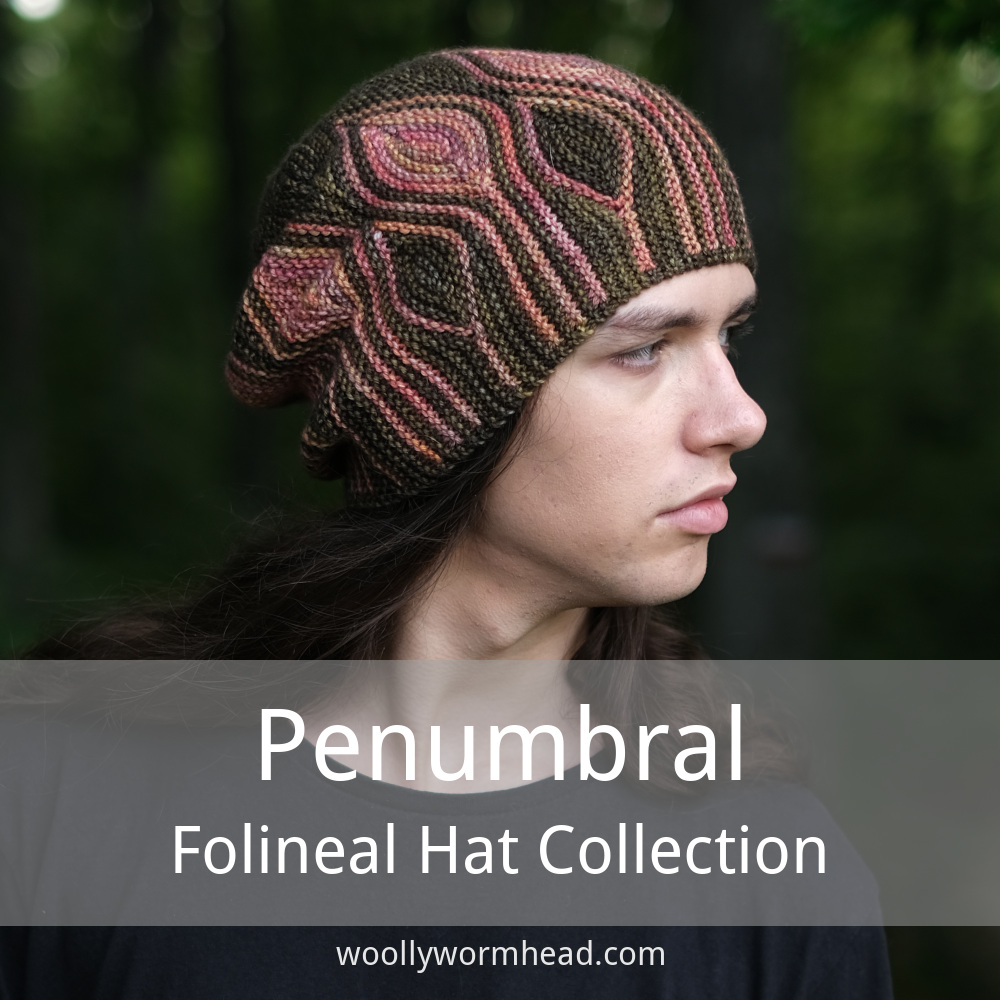
Ever since discovering your sideways technique, I am addicted to making your hats! When making the Penumbral hat I got confused when I had to slip stitches at the end of a row and then again at the beginning of the next row. It felt like I was just moving stitches from one needle and then back again and then I would get confused with what to do with my yarn. It felt like it should be simple and yet I kept getting confused whenever I got to those rows. Thanks.
Yeah, this is a bit of an anomaly when slipped stitches are used that way.
For mapping/charting/instruction purposes, I have to denote them as slipped stitches, otherwise I’d have blank squares and that would be more confusing! I need to indicate what you’re doing with those stitches.
But in practice you don’t need to slip them all, you only need to slip those that get you to the next knitting point.
Have fun with them, knitting Hats sideways is so satisfying!
I love your book! I did start a pattern in a finer yarn suggested by a local yarn store and it worked out. I’m one of those Western knitters unless doing color work. My only problem was forgetting to carry a color till I’d knitted way past. I love that shawl too. Only have done hats so far. Thank you for your concern. My hope is things will get better and we won’t all be judged by the behavior of a few. More people need to craft and garden so they don’t have detrimental hobbies.
Most of the patterns will work with yarns that are a little finer – they’re graded by gauge after all, and the Hats can have an extra panel needed if needs be.
Getting into the habit of carrying the floats is a little different to stranded colourwork, and I still forget to catch them from time to time.
I also would often forget to carry a color while focused on getting the short rows right. I had never really done much colorwork or float management before knitting the Damascena shawl, so there a couple of embarrassing spots in the back.
I love the shawl, love the book, and love what I learned from reading the book and trying these techniques.
Thankyou for your update. Living here in the US I just hold my breath when checking in with the news and hope we can wait out the next 3 years.
I am working on “Equalised” and this is totally new for me, first sideways knit, having some experience with wrap & turn.With any new pattern I learn a lot.
How I found you:
I never wore hats, didn’t like anything on my head. So I only knit hats for friends or because I liked a pattern I found. Cancer treatment and loss of my hair changed all that. So looking through my library of patterns I found a couple of yours, probably published in other collections. I immediately fell in love with your name and the many of patterns you have written. I guess I am now a Woolly Wormhead “head”.
I was able to get “Short Row Colorwork” and “Knit Hats with Woolly Wormhead”.
I am working on learning GSR, and I appreciate your very clear tutorials.
I have no sugestions yet, I have to work out what I am doing for a while.
Here’s hoping everyone is feeling better soon. Peace.
I’m glad you’ve found the world of sideways knit Hats and the fun they can be. German Short Rows are great, too.
And I hope you recovered well!
I love looking through your book, my goal is to knit all the swatches & hang them on my wall so when I’m on a zoom, everyone can see them. I’m up to Heartbeat, however, the short-rows are just messy when I resolve the row. I’ve had some friends tell me it’s my tension (too loose), or to try W&T & ignore the pickup of the wrap. The W&T done incorrectly (wrapping the yarn all the way around choking the wrapped stitch) seemed to look & work the best. I will persevere!
I love it when I see the swatches knitted up – it’s great to play with them, even better to display them!
When it comes to short rows, there isn’t one definitive answer – everyone’s tension is different, knitting styles are different, and that all means that not every short row method works for everyone.
Some people can use W&T in Garter Stitch and just knit over the wraps no problem, but I get a hole if I do that. Some people can just turn and use no short row method – of which I’m very envious – but again, it won’t work for everyone.
It is to some extent trial and error, and swatching, to see which works best for you.
I recommend GSR for short-row colourwork because they’re quick, easier to graft, easier to knit backwards, and so on. They have their downsides too, and if you have a looser tension then those downsides will be more noticeable (they can be a little lumpy on the wrong side)
I always have to find a resource for Kitchener stitch. There has to be a limerick, rule, something so I don’t have to stop and go find a guide to cont.
Grafting Garter Stitch or Stocking Stitch?
Garter is much easier, as it’s the same on both needles. But it does need some thought in set up. I don’t know if there’s quick way to remember it, but I usually just go “Knit off, Purl On” and that works.
Stocking Stitch is trickier because it’s the opposite on each needle, and even though I spend a daft amount of time grafting, I still have to pause for a moment to remember!
I was knitting a hat from Elemental when I bought Short-Row Colorwork–which I love! However, I preferred the lengthy explanation in the pdf “Grafting Garter Stitch aka Kitchener” because I kept getting confused using the book’s “Grafting German Short Rows.” I was probably missing details because the instructions are so compact in the book, and “creating the beginning selvedge” (book) vs “grafting the selvedge”…that was already there…(pdf) doesn’t make sense to me.
Thank you for adding so much beauty and creativity to our world!
Changing colors, weaving in ends, do superwash and non-superwash wools behave the same way in terms of the short rows? And what is the point of wrap & turn? I’ve read it isn’t needed in garter stitch, which most of your designs consist of. For the cowls, if I wanted them to be taller or if I converted it into a scarf, how do I add more stitches while keeping with the short row design?
That’s a lot there – I’ll see what I can do!
In terms of short row methods, I explained that 2 comments up – there isn’t a one method fits all. I prefer GSR for several reasons in short-row colourwork, but I think I probably need to do an article or video explaining the differences (and how they work differently for different people) in general short row usage, and in short row colourwork.
For extending the height of the cowls, it’ll depend on the cowl, and that will be easiest answered on one of the forums. Using heavier weight yarns is one way to do it. Some might have points of extension, otherwise it’s making the borders wider 🙂
Hello,
I have several of your hat patterns but have not tried any that have designs using short rows. I am happy to know about your book about the topic. I have just added the book to my wish list. Thank you!
oh, you’re about to dive into some fun knitting! They’re a little different, and if you need help then do post on one of the forums and we’ll help you out. But they are rather magical as they grow on needles 🙂
Maybe this is in the book because I’ve only dipped into parts of it, not read.cover to cover, but I’d like more information about using short row color work motifs as a part of shaping.
I touch on that in the design chapter at the end of the book, but designing with short-row colourwork is probably a book in and of itself. I teach a workshop on it, and I need to get a recorded version for the website.
The best place to start is looking at the shawls in the book to see how increases have been used around the Repeatable motifs, then compare those maps with the ones in the stitch dictionary. And then the sideways Hat, as short row shaping has been used within the motif.
How to incorporate short row colourwork into existing patterns. Say you have a sweater pattern that is plain but you wanted to put a row of motifs round it or a column of them up the sleeves etc. Instructions as to how to adapt the pattern would be helpful. Thank you ☺️
That isn’t within the scope of the next Biggety Big project, but it’s something I touch on in the design chapter in the current book. I’ll see if I can find some basic ideas together for a video as a jumping off point 🙂
I started the Juxta but got totally confused about the “SR” at the very end of the even rows. I reread your short row instructions, consulted the book, looked on your videos and reworked everything but just gave up. I’m just not understanding the directions. Is the SR identifying a short row or is it actually a stitch I need to do. I would love to be able to view a few short videos regarding the technique for this beautiful hat. Thank you very much!
‘SR’ is in the Abbreviations- it means: “perform short row. For the wrap & turn method, this is the stitch that is wrapped. For the German Short Row method, this is the double legged stitch.”
For these patterns you can use either method, whichever is your preference. Just make sure to do either the W&T or the create the double-legged stitch on the next stitch after the instructions 🙂
I agree that I would love to see an expanded design chapter, why certain motifs work better in different shapes, how to incorporate motifs into existing patterns, how to enlarge or reduce the size of a given motif. All designs questions, maybe an enlarged or separate design book?
Yeah, that is definitely a book unto itself! I do teach a design with SRC workshop, but it hasn’t been the most popular so it doesn’t get booked often. I’m considering making it into a pre-recorded class here on the website.
A design book is more niche than a stitch dictionary come pattern book, and I don’t know if my publisher would go for it. The first book had a chapter on it, but not in any great depth, and the next book will also approach the idea from a different direction, which I hope will help.
I always suggest looking at the patterns in the book and noticing how the shaping has been worked in or around the motifs – that’s a good starting point 🙂
I haven’t got anything to ask yet, but I’m finally back to the cold and snowy midwest US and ready to knit some more hats.
I’ve knitted a handful of your hats, starting with Toph, which I made for all three girls in my immediate family. I love your patterns, and besides the book, I’ve bought quite a few patterns on ravelry.
Just wanted to reiterate how much I love your patterns, and sideways hats. I’ve made some Shetland Wool Week hats, but though they are fun, I love yours the most. 🙂 Keep up the good work, and I look forward to the newest biggety big project.
Thank you!
I love the patterns in your book and it is the only knitting book I’ve actually given as gifts cause it is truly practical and “digestible”. I hate knitting in the round and flat knitting is a must for me. I’ve tried to make scarves using the “stackables” but they come out way too narrow and when I broaden the borders the pattern is somehow less spectacular and gets swallowed up. I’ve tried using heavier wool but using “chunky” wool also diminishes the pattern. Is there an explanation I’ve missed in the book? Is there a way to calculate how to make them a bit wider without having to broaden the borders?
The short answer is that it depends on the motif! Like any stitch dictionary, they all work on a different stitch count over a different number of rows, so you’ll likely want to lean towards a wider motif if you don’t want to use a heavier yarn. One scarf pattern in the book uses worsted (Rios), combining 2 motifs, and it works well.
Some of the motifs have points where they can be widened, but not all. They’re not shown in the book as it was already getting rather full of information and I didn’t want to cause any confusion. But I think it would make for a helpful video to show how to widen the motifs, and what to look for to see if it’s possible. Obviously this will alter the motif, but sometimes it might only be leaf stalks or leaves, and won’t look distorted.
I’ll add this to my video tutorial list. I’ve had lots of great suggestions in the comments!
I have knitted the Etereo pattern from your Folineal ebook, but I have to use DK-weight acrylic yarn, and I cannot hold needles any thinner than 3.75mm, so I haven’t been able to “achieve the required gauge”. This means I have had to “fiddle” with the pattern a bit, and knit 1 fewer chart-repeats, to make a hat that fits round my head. The hat has turned out too slouchy for my liking, as my knitting ended up too wide.
I was lucky enough to receive your SRC book for Christmas, and have been trying to understand the “design” section, with the hope of making sideways, garter-stitch SRC hats with less slouch than the Folineal hats. I can’t find the section of the book that tells me how to add borders to your “flat” motif sample charts, so I can’t work out how to extend the motif-charts to the right for the brim, and I can’t work out how to add crown-shaping to the left-hand side of the charts, so as to use your motifs for sideways-knitted hats. I have studied the Fogrande hat-pattern in the SRC book, but I still can’t understand which SR’s form the crown-shaping and which form the actual motif, so I am completely stuck! Is there some extra information that you wanted to add to the SRC book, but didn’t have the space for it? Can I find that information elsewhere, or am I just misreading what is already part of the book?
In the Folineal patterns, I have been trying to work out how to take a vertical “slice” of about 6 sts out of the hats, to reduce the slouch, but I haven’t been able to do it, because I can’t tell which SR’s are part of the crown-shaping, and which belong to the motifs.
Could you help me, please?
Hello. I have your book and some of your other patterns. I’m so much inspired by your creativity and all the thought and effort that you have obviously put into your patterns.
I like to work some of your patterns into the cardigans I knit. So, it would be useful if, as well as numbering rows, you could also indicate how many rows or (ridges) a given repeat equates to.
Thank you for your first book. I have enjoyed it thoroughly and have learned interesting techniques.
In a new book, could you please show how a left handed person can do provisional casting and obtain stitches oriented the right way. If the stitches are not turned at the beginning as they are casted on, undoing them at the end for the seam is a challenge. Thank you
The page count will be limited, and I suspect my publisher won’t be able to stretch it to include photo tutorials for left-handed knitters – there won’t be space for them in Continental either, I don’t think.
That said, we’re aiming to include QR codes to video tutorials, so that is something I can cover there! However, I’m not a left-handed knitter, have never tried, so will need to do some research. What do you mean by:
Do you mean the stitches aren’t orientated correctly when you remove the provisional cast-on? Because that’s an issue right-hand knitters can face too. But I wouldn’t mind understanding what you mean a bit more before I can help. If you have images you can post them in my Rav group or on my forum here, then I can have a look 🙂
Yes, the stitches are not oriented the right way. So one needs to change the orientation before knitting them. Not a huge issue but there must be a better way.
Ok, this is a problem for most people! I have the same issue.
In my videos I suggest removing the provisional cast-on in the way that’s most comfortable for you – which for most people means they’re not orientated correctly – then re-orientate them once they’re on the needle. It’s more important to catch the stitch(es) than get the right orientation, as one is much easier to fix than the other.
If you do want to get their orientation right each time, then you need to insert your needle differently – from the opposite side – which is more fiddly.
your Short-Row Colorwork book is one of four i’ve kept from recent purging. it’s too precious! also, it was gifted to me two christmases ago. however, i haven’t done any of the patterns in it! why oh why? i have your Frequential, Elemental, Folineal ebooks and i’ve knitted lots of hats out of those. i’m thinking that perhaps it’s the medium, that maybe epatterns are more convenient for me. so, my question has not to do with any specific technique or pattern but about the book itself. would it be possible to access an electronic version of the book or specific patterns from it after proving that one already owns the physical book? although the latter might be the tricky part hmm.
Folks have asked for an electronic version, and the short answer I’m afraid is that it’s not up to me. My publisher (Sixth&Spring/Vogue Knitting) have always been a print-only publisher. Whether that’ll change going forward I don’t know, but that’s not a decision for me to make. If it comes up in discussion I’ll certainly let them know that plenty of folks have asked for it!
I had a fun time making a few hats from the book, but I’m super visual and had hit a bump in understanding the charts. The charts are very clear, mind you, but they are very *linear* while the finished hats are rounded. I ended up drawing a few curved grids/grided wedges to help me imagine what I’d be knitting a little better. A few blank doodles like this in the back of the book, or available on your website after purchase, would be tremendously helpful for those of us who apparently require an adult coloring page to orient ourselves. I don’t usually knit in the round, so I’m as surprised as anyone that I ended up with a curvaceous hangup haha!
Yes, they can be hard to visualise! Do you mean like a colouring image – the shape of the finished panel, with the outlines, so you can colour them in? I’m thinking colouring in as it might help with colour choices as well as definining the shape.
Or have I misunderstood what you mean?
Hello, I have been doing a deep dive on short row colorwork in the hopes of designing my own project, and I’ve found your blog posts tremendously helpful!
I am very curious about your design process for these patterns – are you able to chart out visually what the design will look like, and then translate that into an actually legible knitting pattern?
I am hoping to make something that appears random without repeating motifs, but I know that if I just make short row shapes without a plan, my stitch columns will not end up “balanced.” If I could sketch out my irregular visual design and somehow translate that into balanced short row shapes, that would be solve my problem!
I’ve started puzzling away at this, but figured that short-row pattern designers may already have the answer.
This is probably too complex a question to answer in a single comment – I read something in the comments here about an upcoming book with a design section? If that’s the case, I’d be very excited to read it!
Thank you 🙂
Designing with SRC is really a book in and of itself! There is a design chapter at the end of the first book that offers some ideas, but doesn’t deep-dive. The equivalent chapter in the forthcoming book won’t be as deep, and more specific to the content of that book, so I’m not sure it’ll be as helpful.
Sometimes I visualise the motifs first, or at least what I want to aim towards, and sometimes I let the short rows decide. I work within a spreadsheet with formulas set up to ensure the fabric is balanced and that I’m not getting any stacked short rows.
Making something appear random without repeats is going to create a LARGE map, as standard charting methods just don’t work for short rows in the same way.
I am working on some new video tutorials about the maps – how to balance them, how to read them etc, and I think they’ll offer some useful insight into how to construct them, and from there how to design with them.
Honestly though, I’d start with the motifs in the first book, or adapt a pattern of mine, to see how the stitches and rows play together 🙂